Schedule a FREE Estimate | Paver Sealing | Paver Cleaning and Restoration | Pressure Washing
How Often Pavers Need Resealing in Florida
In Southwest Florida, most sealed pavers need attention roughly every two to four years, and sooner on pool decks, full-sun driveways and anything close to salt water. That is shorter than the schedule quoted for cooler states. Treat the calendar as a starting point only. The surface tells you more: how water behaves on it, how the colour looks, and what is happening in the joints.

The short answer, and where the numbers come from
The ranges on this page are rules of thumb. They come from how sealers behave under heavy sun and rain in general, the maintenance guidance sealer makers publish for hot climates, and what we see on Southwest Florida surfaces. They are not laboratory figures, and no honest contractor can give one number that fits every driveway. Two neighbouring houses can be a year or more apart.
TYPICAL RANGES FOR LEE COUNTY
| Surface | Typical interval | What pushes it shorter or longer |
|---|---|---|
| Driveway in full sun | 2 to 3 years | Tyre traffic, heat, parked vehicles, irrigation overspray |
| Pool deck or open lanai | 1 to 3 years | Direct UV, pool chemicals, constant wetting, foot traffic |
| Shaded walkway or entry | 3 to 4 years, sometimes longer | Algae growth in shade, tree debris, sprinkler staining |
| Waterfront or canal-side | Toward the short end | Salt air, spray and humidity |
Reviews From Happy Homeowners
Our customers share their experience with quality workmanship, honest recommendations, and lasting exterior improvements.
Why Florida shortens the interval
A sealer is a thin protective layer, and this climate attacks it from several directions at once.
- Direct UV most of the year. Sun breaks down sealer resin and fades the colour underneath. Film-forming sealers tend to dull and go chalky before they fail outright.
- Daily rain through the summer. Repeated wetting and drying, plus afternoon heat on a wet surface, works on the sealer and on the joint sand.
- Salt air near the water. Salt is abrasive and hygroscopic, and it speeds up wear on properties close to the Gulf, canals and the river.
- Iron in irrigation water. Sprinklers leave rust-coloured stains. A sealer in good shape keeps much of that on the surface where it can be cleaned, and a worn one lets it soak in.
- Surface heat. A dark driveway in July gets hot enough to soften some film-forming sealers, which is how hot tyre pickup happens.
- None of this means sealing is a bad idea here. It means a schedule copied from Ohio will leave you resealing late.
How to tell by looking, not by the calendar
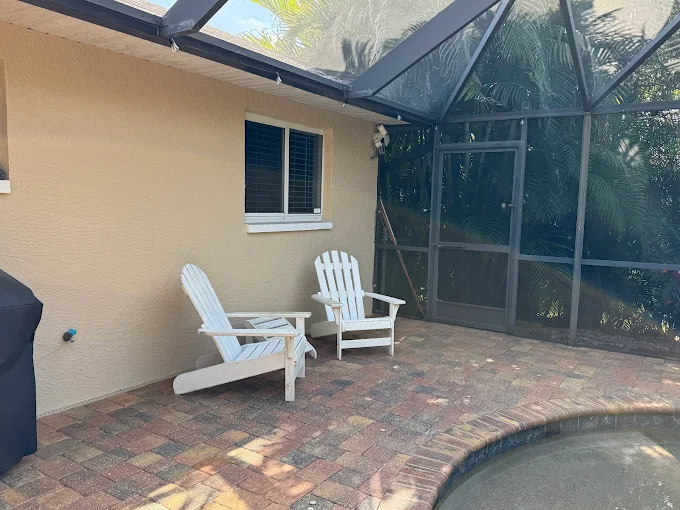
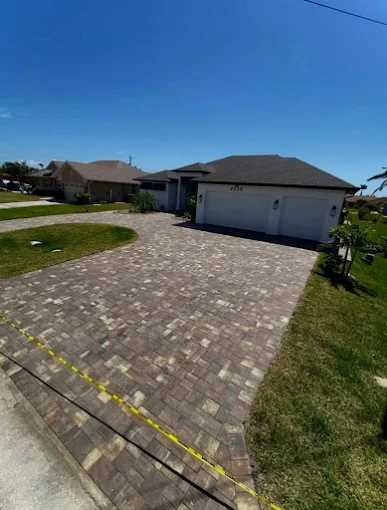
Stand on the surface after a rain or while the sprinklers run, and look at these things:
- Water behaviour. Sealed pavers usually hold water in beads or a surface sheen. If it soaks in and darkens the paver, the sealer has worn thin.
- Colour. Flat, chalky or patchy colour, especially where the sun hits hardest, points to UV wear.
- Wear patterns. Look at the tyre tracks, the route from the door to the car and the edges near the pool. Sealer goes first where traffic is heaviest.
- Staining. Oil spots, rust marks and algae that keep coming back and are harder to clean mean the surface is no longer protected.
- Joints. Sand washing out of the joints lets pavers shift, lets weeds in and exposes the edges. That is a separate problem from the sealer, but the two are usually checked together.
One or two of these is a reason to keep watching. Several at once is a reason to get it looked at.
Film-forming versus penetrating: they wear differently
Sealers fall into two broad families, and the family changes what failure looks like.
Film-forming sealers
Sit on top of the paver as a coating. They can deepen colour and add sheen, and they protect well against stains, but they wear visibly: gloss dulls, tracks appear and the coating can peel or cloud where moisture gets under it. Some are solvent-based and some are water-based, and they behave differently in heat and humidity.
Penetrating sealers
soak into the paver and leave little or no surface layer. They wear out of sight, so they are harder to judge by eye, and they usually change the appearance less. The water test matters more with these.
Neither family is better in every case. The right one depends on the paver, the exposure and what you want the surface to look like.
Wet look versus natural finish
This choice affects how often you reseal, so it belongs in the conversation, and there is a fair case on both sides.
Wet look
Deepens and enriches the colour, and many people simply prefer how it looks. The trade-offs are that wear shows sooner as the gloss dulls, the surface can be slicker when wet, and it often costs more in product and prep.
Natural finish
Keeps the paver close to its original colour and hides wear better, so a tired seal is less obvious. The trade-offs are less colour depth and, depending on the product, less stain resistance.
White haze changes the answer
Before resealing, look for a white, powdery or cloudy haze on the pavers. This is usually efflorescence: mineral salts carried up through the concrete by moisture that stay behind as the water evaporates. Florida produces plenty of it, thanks to humidity, summer rain, a high water table and irrigation, and new pavers are especially prone.
It matters here because sealing over it can trap it, and it can become a permanent cloudy patch under the coating. It has to be dealt with before any sealer goes down. If a contractor quotes a reseal without looking for it, or brushes it off, that is a warning sign. Doing the work in the right order is the difference between a seal that holds and one you regret.
Too early and too late both cost you
Too early
Adding new coats on a sealer that is still working can build up film-forming layers, which may cloud or peel and make the next job harder.
Too late
Once stains soak in, joint sand washes out and colour fades, the job changes from a reseal to cleaning, repair and sometimes stripping the old sealer. That costs more in effort and money.
The window between those two is wider than people think, which is why checking the surface beats guessing the year.
What a reseal involves, and why it is contractor work
A proper reseal is mostly preparation. The surface is cleaned of dirt, algae and failing sealer, checked for efflorescence, stains and loose joint sand, and left to dry fully. Sealing then happens inside a suitable window of temperature and weather, and the surface needs time to cure before it takes traffic.
This is not a weekend job. Sealers have application windows, and a pressure washer can blow out joint sand, scar concrete and etch softer stone. The work is worth paying for mainly because of the preparation and the timing.
Common Questions
How often should pavers be sealed in Florida?
Can pavers be sealed in the summer?
Do pavers have to be sealed at all?
Does sealing make pavers slip-proof?
How do I know if my sealer is failing?
Can I seal over white haze on my pavers?
Call us today
If you are not sure whether your pavers are due, tell us where the property is and what the surface looks like. We will give you a straight answer, including when the answer is to wait another year. Call Spotless Solution at 239-341-9788 .