Schedule a FREE Estimate | Paver Sealing | Paver Cleaning and Restoration | Pressure Washing
Wet Look vs Natural Finish

What each finish actually is
Both are sealers, and both slow down staining and water absorption. The difference is what they leave behind and where they sit.
Wet look
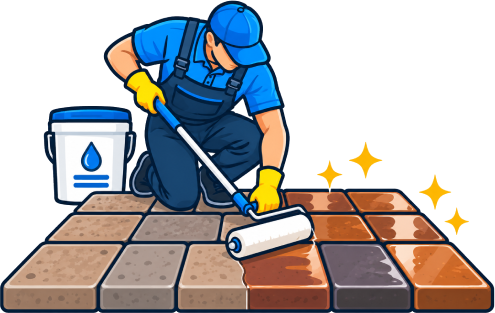
A film-forming sealer, usually an acrylic, that builds a layer on top of the paver. It deepens color, evens out tone and gives a visible gloss, from a soft satin to a hard shine depending on the product and the number of coats.
Natural finish
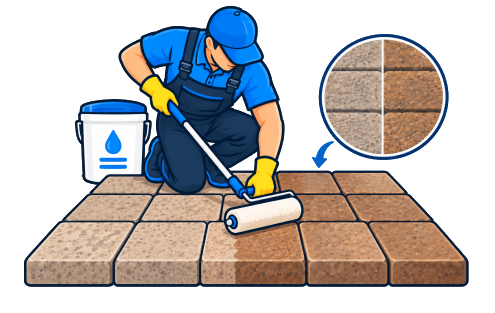
Either a penetrating sealer that soaks into the paver and leaves very little on the surface, or a low-sheen film-former. Color stays near what the dry paver looks like, with slight deepening on some pavers.
Solvent-based film-formers generally give the stronger color and gloss and are the usual choice for wet look. Water-based products tend to give a softer result with less odor. Both have application windows tied to surface temperature and moisture, which is one reason this is work for someone who does it daily and not a weekend project.
What each looks like after a year in Southwest Florida
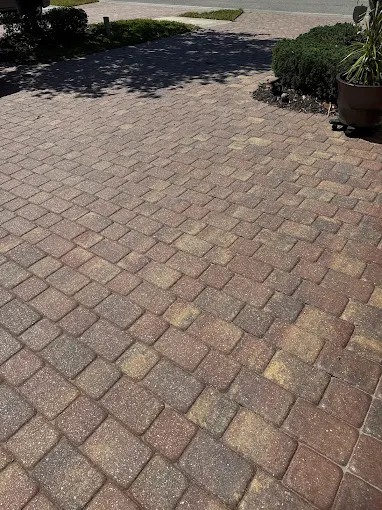
Wet look after a year
- The gloss dulls first where the sun hits hardest, which usually means open driveways and south-facing walkways.
- Color stays rich, but wear in wheel tracks and foot paths makes the sheen uneven.
- Hot tyre pickup is the common driveway complaint. A hot tyre can soften a film-forming sealer and leave dark marks in the coating.
- Any moisture trapped under the film can show up as cloudy or white patches.
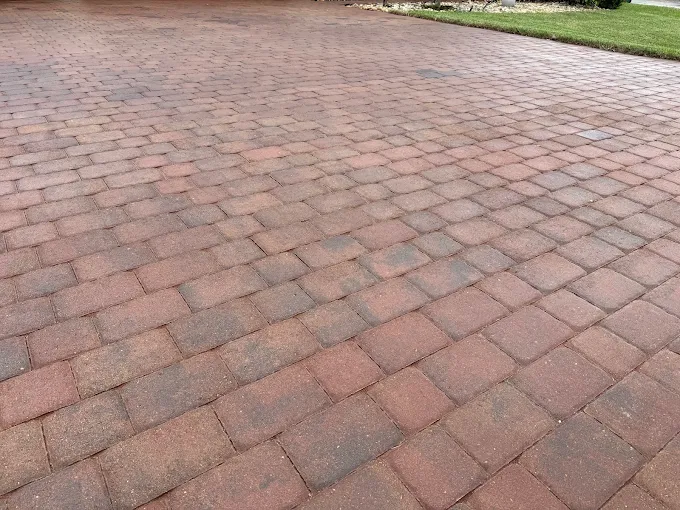
Natural finish after a year
- Very little changes to the eye. That is the point, and it is also the drawback: you cannot easily see when protection is wearing thin.
- Oil and stain resistance stay useful on a penetrating product, but you will not get the rich, freshly wet color back with it.
- Pavers look like clean, dry pavers. Some owners love that. Others feel they paid for sealing and cannot see it.
Pool deck versus driveway
The same finish behaves differently on these two surfaces because the demands are different.
Pool deck and lanai
Driveway
Here the demands are vehicles, oil drips, hot tyres and sun. Wet look gives the richest color and hides uneven fading, but shows tyre marks and wears in the wheel tracks. A natural finish, especially a penetrating one, resists oil well and never peels or scuffs as a film can, but it will not give the glossy look. A driveway is also the surface where people most often choose wet look, because nobody walks barefoot on it.
It is common to end up with different finishes on different areas of one property. That is a legitimate choice as long as the transitions are planned.
Traction: what you can and cannot say
Neither finish makes a surface slip-proof, and a contractor who tells you otherwise is selling you something. What can be said honestly is narrower:
- A glossy film is smoother than the paver it covers, and smoother surfaces are slipperier when wet.
- A natural finish keeps the paver's texture mostly intact, so traction is closer to what the unsealed paver gives you.
- Some film-forming products can be mixed with a traction additive. Additives change the look and feel and carry their own trade-offs, so ask what is in the product and how it was chosen.
- The paver itself matters. Smooth travertine and a textured concrete paver behave very differently when wet, sealed or not.
If children, older family members or anyone unsteady uses the area, treat traction as a first-order question, not an afterthought.
How each ages
Film-forming sealers wear as a layer. You see the sheen fade, then scuffing, then in some cases clouding or yellowing. The fix is cleaning and a fresh coat, and the appearance you paid for needs that recoat to stay.
Penetrating sealers have no film to wear through, so they age quietly. Protection fades gradually and with few visible signs. That is convenient until a stain lands on a surface that stopped repelling it a year ago.
In Southwest Florida, film-forming sealers commonly need attention somewhere in a range of roughly two to four years. Penetrating products often go longer between treatments, but the gap is wider and harder to judge by eye. These ranges come from general trade experience, not from a warranty or a manufacturer promise, and your own surface can fall outside them. What moves the number:
- Direct UV, which is close to constant here
- Daily summer rain and standing water
- Salt air near the coast, canals and the Gulf
- Irrigation water carrying iron, which stains whichever finish you pick
- Traffic, including vehicles and furniture
- The paver itself, how porous it is and how well it was prepared
- The product and how much of it went on, which is why a low bid that skips prep often costs more later
Efflorescence, and why it affects both choices
Efflorescence is the white haze that comes up through pavers. It is mineral salt carried to the surface by moisture moving through the paver and the base beneath it. Southwest Florida produces it more than most places: heavy summer rain, a high water table, irrigation and humidity keep moisture moving, and new pavers are especially prone.
It has to be dealt with before sealing, whichever finish you choose. Sealing over it locks it in, and under a glossy wet look film the result is a cloudy, white haze that is very hard to correct later. A natural finish shows the haze less, but the problem is still there underneath. A contractor who seals over efflorescence is storing up a problem for you. If a bid does not mention how it will be handled on a surface that has it, ask.
Reviews From Happy Homeowners
Our customers share their experience with quality workmanship, honest recommendations, and lasting exterior improvements.
TYPICAL RANGES FOR LEE COUNTY
| Wet look | Natural finish | |
|---|---|---|
| Appearance | Deeper color, visible gloss | Close to dry paver color, little or no sheen |
| Type | Film-forming, usually acrylic | Penetrating or low-sheen film |
| Traction when wet | Smoother, less traction | Keeps more of the paver’s texture |
| Driveway issues | Hot tyre marks, uneven wear | Less visible wear, no gloss |
| Aging | Sheen fades, scuffs, may cloud | Quiet, hard to see when it is wearing |
| Reversibility | Hard to remove later | Easier to add to later |
Changing your mind later
- Natural finish to wet look: usually the easier direction. A film can generally be added to a clean, prepared surface, provided the new product is compatible with what is already there.
- Wet look to natural finish: the harder direction. The film has to come off before a penetrating sealer can reach the paver. Stripping is a chemical and mechanical job with its own cost, and pavers can be damaged by doing it badly.
- Any change of product: compatibility matters. Some sealers will not bond to others, and a contractor should ask what is on the surface before proposing anything.
- The practical lesson is that the decision is reversible in one direction much more easily than the other. If you are genuinely undecided, that favors starting with the more reversible option.
What the choice does to cost
We will not quote a figure here, because price depends on square footage, the condition of the pavers, the prep needed, how many coats go on and the product used. The shape is easier to describe:
- Wet look usually costs more up front, because it takes more product, more coats and more careful prep, and it costs more over time because the look needs recoating.
- Natural finish usually costs less per application, though some penetrating products are priced higher per gallon.
- Stripping a wet look film later is an added cost that does not exist if you start natural.
Our paver sealing cost guide covers what drives price in more detail.
How to decide
Natural finish tends to fit when
- The area is a pool deck, lanai or any surface with wet feet
- You want low visual maintenance and do not need a glossy look
- Oil or stain resistance matters more than color depth
- You are unsure and want the option that is easier to change
Wet look tends to fit when
- You want the deepest color and are happy to recoat to keep it
- The pavers are faded or uneven in tone and you want that evened out
- The surface is a driveway or walkway away from water and bare feet
- You accept the traction and upkeep trade-offs knowingly
Plenty of properties end up with both, natural around the pool and wet look on the drive. What to avoid is choosing on a photo alone. Sun, rain and your own pavers change how either finish looks.
Common Questions
Is wet look sealer slippery?
Will a natural finish make my pavers look wet?
Which finish lasts longer in Florida?
Can I switch from wet look to natural finish later?
Does either finish stop efflorescence?
Can I use a wet look on a pool deck?
Call us today
If you are deciding on a specific driveway, lanai or pool deck, call Spotless Solution at 239-341-9788 . and ask for a look at the surface before you choose a finish.